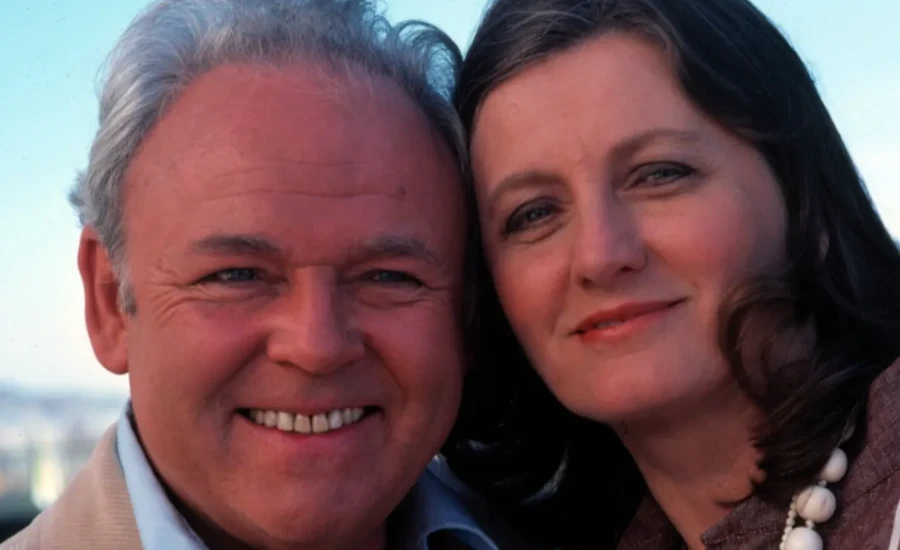

To millions of people, Carroll O’Connor was best known as Archie Bunker. That name, that character, that growling, opinionated, sometimes maddening face became one of the most unforgettable figures in American television history. And Carroll himself was vocal about one thing: he never would have said yes to that role without his wife.
Nancy Fields O’Connor convinced him to take the part that changed everything. She pushed him toward the role he was most reluctant about. And then she stepped back, let him shine, and quietly spent the next four decades doing extraordinary work of her own, in art, advocacy, philanthropy, documentary film, Native American preservation, and cancer research.
That’s the story most people never heard. This is it.
Quick Facts Table
| Detail | Information |
|---|---|
| Full Name | Anne Kathleen Fields O’Connor (went by Nancy) |
| Born | December 13, 1929, Spokane, Washington |
| Raised | Missoula, Montana (primarily); also Libby, Billings, and St. Maries, Idaho |
| Heritage | Native American (Crow Indian Tribe, per her official obituary) |
| Parents | Ralph Fields and Hulda Miller Fields, both University of Montana graduates |
| Grandfather | Fred E. Miller, historic photographer of the Crow Indian Tribe |
| Siblings | One brother, John Fields |
| Education | University of Montana, B.A. in English and Drama (1951) |
| Husband | Carroll O’Connor (married 1951, Dublin, Ireland; died June 2, 2001) |
| Son | Hugh O’Connor (adopted 1962; actor; died by suicide May 28, 1995) |
| Daughter-in-law | Angela O’Connor (Hugh’s wife) |
| Grandson | Sean O’Connor |
| Major Roles | Artist, author, activist, philanthropist, documentary film producer, founding member of John Wayne Cancer Institute |
| Notable Book | Fred E. Miller: Photographer of the Crows (Carnan Vidfilm, 1985) |
| Notable Film | Executive producer, Anita O’Day: The Life of a Jazz Singer (2007 documentary) |
| Acting Credits | A Whale of a Tale (1976), The Celluloid Closet (1995), The Mike Douglas Show (1961) |
| University Legacy | The Carroll and Nancy O’Connor Center for the Rocky Mountain West, University of Montana |
| Board Memberships | John Wayne Cancer Institute, Actors Fund of America, Smithsonian National Museum of the American Indian, UM Fine Arts Advisory Committee |
| Death | November 10, 2014, Malibu, California, from Alzheimer’s disease complications |
| Burial | Pierce Brothers Westwood Village Memorial Park, Los Angeles |
A Montana Girl With Roots Deep in the Land
Nancy Fields grew up in a family that understood both the earth and education. Her parents, Ralph and Hulda Miller Fields, both graduated from the University of Montana and went on to work for the U.S. government. Forest Service, which meant the family moved around the American Northwest as the work required.
She spent time in Libby, Montana. In Billings. In St. Maries, Idaho. And most significantly, in Missoula, the university city that would shape everything about who Nancy became.
Nancy was born on December 13, 1929, in Spokane, Washington. Although her birthplace was Washington, her lifelong ties to Missoula led many people to identify her with Montana. Her mother, Hulda Miller, was the daughter of Fred E. Miller, whose legacy would later play a major role in one of Nancy’s most meaningful projects.
The University of Montana Changed Her Life Twice
Nancy enrolled at the University of Montana, studying English and Drama. She graduated in 1951. That degree, in a department she cared about and excelled in, set her up for everything that followed.
But the more immediately life-changing event of her university years wasn’t academic. It was a production. Specifically, a Drama and Fine Arts Department production of Life With Father.
In that production, she met a fellow undergraduate named Carroll O’Connor. Both of them were involved in the same theater world at the same school. They were drawn to the same kind of creative work. And what began as shared artistic interest became something permanent.
A Wedding in Dublin, 1951
Later in 1951, Nancy Fields married Carroll O’Connor in Dublin, Ireland, where Carroll was studying at the time. The ceremony was a Roman Catholic wedding, reflecting both the Irish-American Catholic tradition Carroll came from and the religious faith that Nancy shared.
A wedding in Dublin is not a small or incidental detail. It suggests a couple who were already adventurous, already willing to build their life across an international landscape, already committed to each other before either of them had any professional reputation worth protecting or pursuing.
That spirit, a willingness to show up for each other before the cameras arrived, defined their entire partnership.
The Role She Talked Him Into
Carroll O’Connor went on to become a serious, working actor across film and television through the 1960s. He had real credits, real training, and real respect in the industry. But he wasn’t yet the household name he would become.
When the offer came to play Archie Bunker in a new CBS sitcom called All in the Family, Carroll hesitated. He had reservations. The character was a bigot, loud and often wrong, and Carroll wasn’t sure he wanted to attach himself to that.
Nancy told him to take it. She convinced him that the role was an opportunity, not a trap, that playing a character you disagree with is different from becoming one, and that the show would say something important about American culture if it was done right.
He listened to her. He took the role. All in the Family debuted in 1971, became one of the highest-rated television programs in American history, and transformed Carroll O’Connor into one of the most recognized actors of his generation.
Carroll spent years publicly crediting Nancy with that decision. He didn’t take that credit for himself. He gave it to her, because it was true.
A Partner in Every Sense of the Word
The word “instrumental” appears in Nancy’s official obituary, describing her as “instrumental in every aspect of his career.” That’s not public relations language. That’s the family themselves saying, on the record, that Carroll’s career was not solely his own creation.
Nancy wasn’t just supportive in the soft, passive sense that often gets attached to that word. She was a strategic, active partner. She read the scripts. She had opinions. She spoke up when something needed to be challenged and offered encouragement when it was deserved.
She also helped shape his public presence, attending events alongside him, contributing to the philanthropic work they pursued together, and building relationships in the industry and beyond that extended Carroll’s reach and reputation.
The Adoption of Hugh O’Connor
In 1962, while Carroll was in Rome working on the epic film Cleopatra, he and Nancy adopted a son. They named him Hugh O’Connor.
Hugh grew up as an actor, following his parents into the entertainment world he’d been raised inside. He had a recurring role on In the Heat of the Night, the television drama his father also starred in during the 1980s and early 1990s. By all accounts, Carroll and Nancy loved him deeply and were devoted parents.
Hugh’s life was marked by a long struggle with cocaine addiction, a battle that affected much of his adult years. Carroll O’Connor addressed the issue openly, later filing a civil lawsuit against a man he believed had played a role in his son’s addiction.
On May 28, 1995, Hugh O’Connor died by suicide. He was 33 years old.
The loss was devastating. Carroll and Nancy never fully recovered from it in the ordinary emotional sense of recovery. What they did instead was channel that grief outward, into advocacy, into their faith, into the work that could still be done on behalf of others. Carroll became a public voice for anti-drug legislation. Nancy continued the philanthropic and artistic work she had always pursued, carrying the weight of that loss into whatever she built next.
Losing Carroll in 2001
On June 2, 2001, Carroll O’Connor died of a heart attack in Los Angeles. He was 76 years old.
He and Nancy had been together for fifty years. Married in Dublin when neither of them knew what their lives would become. Survivors of unimaginable loss in the death of their son. Partners in everything that made their professional and philanthropic world what it was.
Nancy attended his funeral at St. St. Paul the Apostle Church in West Los Angeles. Getty Images documented her presence there, dressed in black, composed in the way that only someone who has already learned to carry enormous grief can be composed.
She outlived Carroll by thirteen years and made the most of that time.
The Project That Connected Her to Her Grandfather
One of the most distinctive and important parts of Nancy Fields O’Connor’s life was a project that had nothing to do with Hollywood. It was about photographs. Specifically, about a collection of over 600 photographs taken by her grandfather, Fred E. Miller.
Fred E. Miller was a photographer who documented the Crow Indian Tribe of Montana between 1895 and 1920. His collection included photographs and 135 glass negatives, a remarkable historical record of a community and a way of life that was being transformed under enormous external pressure during that era.
Nancy spent approximately ten years tracking down, collecting, and cataloging this material. That’s not a weekend hobby. That’s a decade of dedicated work: contacting archives, traveling to see prints, verifying provenance, organizing an enormous body of visual history into something that could be shared and preserved.
She developed a celebrated museum exhibition around the collection. She wrote a book: Fred E. Miller: Photographer of the Crows, published by Carnan Vidfilm in 1985. The collection was shown at art and historical museums across the United States.
As of the time of her death, the Fred E. Miller Collection was on loan to the Great Plains Museum at the University of Nebraska. It represented not just family history but genuine cultural and historical documentation of immense value.
Nancy’s official obituary described her as being of “full Native American heritage from Montana’s Crow Indian Tribe,” and she held a seat on the Board of Directors of the Smithsonian Institution’s National Museum of the American Indian, a role that reflected both her personal connection to Indigenous culture and her commitment to ensuring that history was preserved and respected on its own terms.
Executive Producer: Anita O’Day
In 2007, Nancy Fields O’Connor executive produced a documentary about jazz singer Anita O’Day, titled Anita O’Day: The Life of a Jazz Singer. That film told the story of one of the most influential and complex figures in American jazz, a woman who battled heroin addiction, endured enormous personal hardship, and kept making extraordinary music across a seven-decade career.
The choice of subject wasn’t random. A woman who loved music, who had lived through her own family’s battle with addiction, who had seen what the entertainment industry could give and take from people, was the right producer for a film about exactly that intersection of talent and pain.
The documentary was well received and became a lasting contribution to the documentation of jazz history.
Film and Television: Her Own Acting Credits
Nancy wasn’t only a supporter of other people’s artistic work. She had her own credits.
She appeared on The Mike Douglas Show in 1961, a popular daytime talk and variety program that reached huge audiences. She appeared in A Whale of a Tale in 1976. And she appeared in The Celluloid Closet in 1995, the documentary about homosexuality in Hollywood films that became a landmark work in LGBTQ media history.
That last credit is worth pausing on. The Celluloid Closet was a groundbreaking film about a subject that was still genuinely controversial in 1995. Nancy’s decision to participate in it reflects the same instinct that ran through all of her charitable work: a commitment to causes that mattered regardless of whether they were comfortable or popular.
The John Wayne Cancer Institute and Cancer Advocacy
Nancy was a founding member of the John Wayne Cancer Institute in Los Angeles, an organization built to fund and advance cancer research. In 1990, she and Carroll received the Institute’s Duke Award, given for “outstanding support for cancer research.”
Her family’s tribute requests after her death listed the John Wayne Cancer Institute’s Melanoma Research program as one of the charitable destinations for memorial contributions. That’s a specific sub-specialty of cancer research, suggesting a particular personal connection to melanoma within the family’s experience.
The Actors Fund of America and Veterans Advocacy
Nancy served on the Board of Trustees of The Actors Fund of America, the organization that provides emergency financial assistance, health care access, and supportive services to entertainment industry workers in need. Her presence on that board connected her sense of responsibility toward the creative community with the practical tools to help people in it who were struggling.
She was also described as “very concerned and attentive to veterans’ rights and programs for veterans,” a commitment that reflected the family’s background in communities shaped by military service, including the connection to Hill Air Force Base through her Montana childhood.
She was involved with Neighbors of Watts, a South Central Los Angeles charity. That involvement shows a woman who extended her charitable energy beyond the arts and into direct community support in one of Los Angeles’ most economically challenged neighborhoods.
The University of Montana Legacy
Both Carroll and Nancy gave significantly to the University of Montana, the school where they had both studied and where they had met. Their most significant institutional contribution was a million-dollar gift toward the National Endowment for the Humanities Challenge Grant, which was the largest single private gift toward that match.
In recognition of that support and their long-term relationship with the institution, the University renamed an existing center in their honor. It is now called The Carroll and Nancy O’Connor Center for the Rocky Mountain West, a research and educational center focused on regional history, identity, and culture.
Carroll also returned to the University near the end of his life to teach a popular class called Writing the Movie. Nancy served on the Fine Arts Advisory Committee and played a key role in the development of the PAR-TV Center at the University of Montana.
Their names are now permanently attached to an institution that shaped who they both became.
The Final Years and Alzheimer’s
Nancy was diagnosed with Alzheimer’s disease approximately ten years before her death, meaning the disease began affecting her around 2004, three years after Carroll’s death. She continued to live in the couple’s Malibu home, cared for by family, until the very end.
Her brother John Fields told the Missoulian newspaper in Montana that when she died on November 10, 2014, hospice workers were present and she stopped breathing peacefully. She was 84 years old.
Her funeral was held on November 22, 2014, at Our Lady of Malibu Church in Malibu. She was buried at Pierce Brothers Westwood Village Memorial Park in Los Angeles, alongside her husband.
She had suffered the same disease as her mother, Hulda Miller Fields, who had worked for years in the same community before dying of the same illness.
A Woman Who Refused to Be a Shadow
The Find a Grave memorial for Nancy Fields O’Connor opens with a striking observation. It says she was no Edith Bunker, referring to the meek, devoted television wife Archie Bunker’s character on All in the Family was paired with. It says she was active and involved, a take-charge woman who didn’t pale in the shadow of her famous husband.
That framing matters, because the gravitational pull of Carroll O’Connor’s fame was enormous. Archie Bunker became a cultural icon. The show became a landmark. Carroll won four Emmy Awards for the role. When that kind of fame surrounds a person, everyone beside them tends to become invisible in proportion.
Nancy refused that invisibility. She built her own work, her own board seats, her own book, her own documentary production career, her own relationships in Native American cultural preservation and cancer research and veterans advocacy and South Central community support.
She was a full person doing full work, in parallel with her husband’s career, not in its shadow.
Releated: Julianna Farrait
Final Words
Nancy Fields O’Connor was born in Spokane to a Forest Service family, grew up in Missoula, met her husband in a college play, married him in Dublin, raised their adopted son in Los Angeles, talked Carroll O’Connor into the role that defined his legacy, outlived both him and their son, spent a decade cataloging her grandfather’s photographs of the Crow Indian Tribe, executive produced a jazz documentary, served on boards that protected artists and Indigenous heritage and cancer research, gave a million dollars to her university, and died peacefully in Malibu at 84 after a decade-long battle with Alzheimer’s.
That’s not a supporting role in someone else’s story. That’s a full life, built with intention and discipline and love, shaped by loss but never defined by it.
Her name is on a building at the University of Montana. The Fred E. Miller Collection is in a museum in Nebraska. And every cancer researcher who has worked at the John Wayne Cancer Institute has, in some small way, benefited from a Montana girl who cared about the right things for the right reasons.
FAQ Section
1. Who was Nancy Fields O’Connor?
She was an artist, author, activist, philanthropist, documentary film producer, founding member of the John Wayne Cancer Institute, and the wife of All in the Family star Carroll O’Connor. She died in 2014 at age 84.
2. What was Nancy Fields O’Connor’s real name?
Her full legal name was Anne Kathleen Fields. She always went by her nickname, Nancy.
3. When and where was Nancy Fields O’Connor born?
She was born on December 13, 1929, in Spokane, Washington, though she was raised primarily in Missoula, Montana.
4. How did Nancy Fields meet Carroll O’Connor?
They met in 1951 while both were undergraduates at the University of Montana, involved in a Drama and Fine Arts Department production of Life With Father.
5. When and where did Nancy and Carroll O’Connor get married?
They married in 1951 in Dublin, Ireland, where Carroll was studying at the time.
6. How did Nancy O’Connor influence Carroll’s career?
She convinced him to accept the role of Archie Bunker in All in the Family despite his reservations, a decision Carroll publicly credited her with throughout his life.
7. Did Nancy and Carroll O’Connor have children?
They adopted a son, Hugh O’Connor, in 1962. Hugh became an actor but struggled with cocaine addiction and died by suicide in 1995 at age 33.
8. Who are Nancy O’Connor’s survivors?
She is survived by daughter-in-law Angela O’Connor, grandson Sean O’Connor, brother John Fields and sister-in-law Jo Ann Fields, cousin Mary Reynolds, and eleven nieces and nephews. Miller spent the years from 1895 to 1920 documenting the Crow Indian Tribe in Montana.
10. Did Nancy O’Connor write a book?
Yes. She wrote Fred E. Miller: Photographer of the Crows, published in 1985, which documented her grandfather’s historic photographic collection.
Read Comprehensive Profiles Of Famous Personalities On Discover Released.