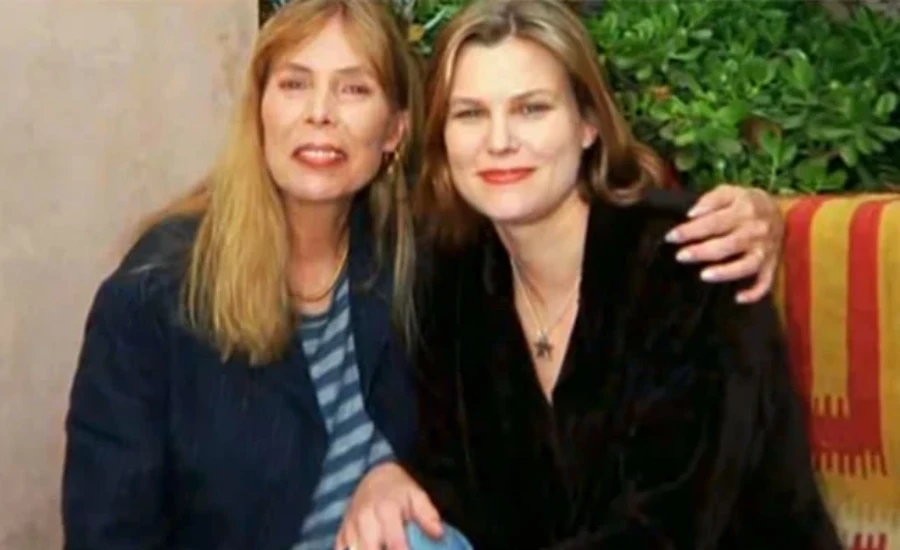

Joni Mitchell wrote a song for a baby she never got to keep. She hid the song inside an album for decades and never explained it publicly. The baby, meanwhile, grew up as someone else entirely, attended private schools, walked runways on three continents, became a mother herself, and had no idea one of the most famous singer-songwriters in history was thinking about her the entire time.
Their story is one of the most quietly extraordinary reunion stories in music history. And it all started with a name: Kelly Dale Anderson.
Quick Facts Table
| Detail | Information |
|---|---|
| Birth Name | Kelly Dale Anderson |
| Adopted Name | Kilauren Andrea Christy Gibb |
| Date of Birth | February 19, 1965 |
| Birthplace | Toronto, Ontario, Canada |
| Biological Mother | Joni Mitchell (born Roberta Joan Anderson) |
| Biological Father | Brad MacMath, Calgary artist and later Toronto photographer |
| Adoptive Parents | David Gibb and Ida Gibb, two Toronto teachers |
| Raised In | Don Mills, Toronto (private schools, comfortable suburban life) |
| Learned of Adoption | Around 1992, age 27, while pregnant |
| Career | Fashion model, 13 years, three continents; later studied desktop publishing |
| Magazine Cover | Chatelaine, November 1983 |
| Children | Son Marlin Kohler (from marriage to Paul Kohler); daughter Daisy Joan (born June 1999, with Ted Barrington) |
| Reunion Year | 1997, in Los Angeles |
| Age at Reunion | 32 years old |
| Song Written for Her | “Little Green” from Joni Mitchell’s 1971 album Blue |
| Relationship with Joni | Private but ongoing; Joni celebrated Kilauren’s 50th birthday with her in 2015 |
A Toronto Hospital, February 1965
The story begins in a Toronto hospital in the dead of winter. A young woman named Roberta Joan Anderson, not yet famous, not yet known to the world as Joni Mitchell, had just given birth to a daughter.
She was 21 years old. She had no money. She had no stable home. The baby’s father, a fellow art student named Brad MacMath, had already made clear he wasn’t ready to settle down and had headed to California.
The social pressure of that era was crushing in ways that are hard to fully understand today. Joni described it herself years later in a 1997 interview with the Los Angeles Times: the stigma of being an unmarried mother in the 1960s felt, she said, like being accused of murder. It ruined you socially. There was no grace given, no support offered, no path forward that didn’t involve shame.
She couldn’t tell her parents. Her father managed a grocery store. Her mother was a teacher. She didn’t want them to carry the weight of this secret alongside her.
Birth complications from the delivery kept her in the hospital for ten extra days. During those days, something changed the shape of everything that followed. She held her daughter. She named her. Kelly Dale Anderson, the baby was called, carrying her mother’s own family surname without anyone outside the hospital ever knowing that connection existed.
Giving Her Up: The Hardest Decision
In 1967, Joni told an interviewer she lost her daughter when she was 21. The word “lost” was precise. She hadn’t abandoned Kelly. She had handed her over to something she couldn’t fight against: the practical reality that she had no money and nowhere to bring a baby home to.
She later described it plainly: she was broke, had no place to take her daughter, had nothing to offer. What she wanted and what was possible for her at that moment were not the same thing.
When Kelly was about six months old, a couple named David and Ida Gibb, both teachers in Toronto, adopted her. They renamed her Kilauren. She would live her entire childhood without any knowledge that she’d been given a different name first, or that her first name had been chosen by a woman who would become one of the most celebrated musicians of the 20th century.
The Song Written From Grief
In 1971, Joni Mitchell released an album called Blue. It’s considered one of the greatest albums in the history of recorded music. Buried inside it was a track called “Little Green.”
For years, people heard it and understood it as a poetic, bittersweet song about a child given up by a young mother. They didn’t know it was literal. Joni was writing about Kelly. She was writing to Kelly, really, hoping the ending the song described, a happy one, would somehow come true.
She kept the real meaning of the song mostly private for decades, referring to it only obliquely in interviews until the secret she’d been carrying was finally broken open by other people. Even then, the song stood as its own private monument to the grief of a young woman who had no choice but to let go of something she deeply loved.
Growing Up as Kilauren Gibb
David and Ida Gibb gave their adopted daughter a life that Joni Mitchell could only have dreamed of providing in 1965. They raised Kilauren in Don Mills, a comfortable Toronto suburb. Private schools. Country club memberships. Tropical vacations every year.
Her adoptive family also included a son named David, who would eventually learn the secret of his sister’s adoption and carry it silently for a long time, which created its own complications later.
Kilauren was, by all accounts, different from her adoptive family in ways she could feel but couldn’t explain. She looked different. Her attitudes leaned more toward the arts than toward academic or athletic achievement, even though she nearly made Canada’s Olympic swimming team as a teenager. At age 11, she started smoking. (Joni Mitchell had started at 9.) She was pulled toward painting, photography, creative pursuits, the same instincts that ran through her biological mother’s entire life.
She had no framework for understanding why she felt the way she did. She just lived inside the feeling, not knowing its origin.
A Modeling Career Spanning Three Continents
At 16, Kilauren Gibb became a professional model. She would work in that industry for 13 years, which means it carried her from her mid-teens all the way into her late twenties.
She wasn’t just working local magazine shoots. She walked runways on three continents, appeared in advertisements for The Bay department store, and in November 1983, she appeared on the cover of Chatelaine, a major Canadian magazine. Fashion week events. Industry parties. She moved through a world of glamour and visibility, working alongside famous faces and traveling constantly.
And in the early 1980s, both she and Joni Mitchell lived in New York City at the same time. Both attended parties in the same social circles. According to Kilauren’s own account, it’s entirely possible they were at Studio 54 on the same night, dancing in the same building, completely unaware they were mother and daughter.
That detail alone, two people who belonged to each other, sharing the same city and possibly the same rooms without ever recognizing each other, makes the eventual reunion feel both inevitable and miraculous.
The Secret That Came Out Anyway
In 1993, one of Joni Mitchell’s former art school roommates sold the story of the adoption to a tabloid. The secret Joni had carried for nearly three decades, through albums, through fame, through two marriages, was suddenly public.
She confirmed it. She described losing her daughter as one of the greatest traumas of her life. She said she’d been trying to find Kelly for years but Ontario’s adoption laws had blocked every attempt.
The public disclosure created a strange new landscape. Impostors appeared almost immediately. A waitress at a Los Angeles restaurant where Joni was a regular went home and asked her mother if she’d been adopted, because her name happened to be Kelly. Dozens of women in their thirties started writing in to say they might be Joni Mitchell’s daughter. The noise made it harder, not easier, to find the real person.
Meanwhile, something was happening on the other side of this search that nobody knew about yet.
Kilauren Learns She Was Adopted
Around 1992, Kilauren’s adoptive parents finally told her the truth she’d never known: she had been adopted as a baby. She was 27 years old. At that point, she was expecting her first child.
Finding out you were adopted at 27, while pregnant, while a tabloid was simultaneously exposing your biological mother’s secret, is the kind of convergence that could break a person. Kilauren responded by starting to search.
She contacted the Children’s Aid Society of Toronto, which held her adoption records. Getting anything useful from them took nearly five years. When a package of non-identifying information finally arrived, it described her birth mother as a Saskatchewan native, an only child of Norwegian-Scottish descent, who had caught polio as a child, attended art school in Calgary, and become a successful Canadian folk singer.
Kilauren read all of that and still didn’t make the connection right away.
The Internet Moment That Changed Everything
On February 1, 1997, Kilauren Gibb sat down at a computer and went to Joni Mitchell’s official website, which had been built and maintained by a fan named Wally Breese. The site described Mitchell’s long search for the daughter she’d given up. It described the details of her birth, her heritage, her background.
Kilauren started counting coincidences. She identified 14 specific points of physical similarity: blue eyes, blonde hair, long legs, high cheekbones. She compared timelines. She looked at the description of a young Saskatchewan art student who had her baby in Toronto in February 1965.
She contacted Breese directly, explaining that she thought she might be the person he was describing. Breese, who had been receiving inquiries from dozens of women who believed the same thing, started corresponding with her. The specific details Kilauren provided, including her exact birth date, began to distinguish her case from all the others.
He put her in contact with Joni Mitchell’s Vancouver-based manager, Sam Feldman. Kilauren faxed infant photographs. Joni had kept photographs of the baby she’d held for those extra ten days in the hospital. The images matched.
After 32 years, the identification was confirmed.
The Reunion in Los Angeles
In March 1997, Kilauren Gibb boarded a flight to Los Angeles, bringing her son Marlin, who was three years old at the time. She was flying to meet the woman who had given birth to her more than three decades earlier.
The first meeting happened at Joni’s home. By Kilauren’s own account, shared in subsequent interviews, the moment they saw each other, they hugged. No awkward pause. No careful introduction. Just an immediate physical recognition of something that had been missing.
Kilauren described the feeling of being in Joni’s kitchen for the first time as coming home after a long trip. Not the overwhelming strangeness she might have expected. Just familiarity. The particular comfort of being somewhere you belong.
Jazz musician Herbie Hancock, who was present during that early period, later said Joni was overjoyed in a way he’d rarely seen her. He watched a woman who had been carrying a private grief for over thirty years step into something that finally let that grief go.
Joni had privately worried that Kilauren might not like her when they finally met. The fear of rejection after all that time, after all those years of searching and hoping, was real. Instead, they spent 19 days together during that first visit. Joni flew Kilauren and Marlin out on first class tickets multiple times in the months that followed.
They sat by the pool. They talked. They discovered that they both played pool, that they’d both married musicians, that the artistic instincts Kilauren had felt pulled toward her entire life without understanding why were the same creative instincts that shaped every album Joni had released throughout her career.
Joni described the reunion by saying her daughter had her own mother’s stature, and that cheekbones ran deep on every side of their combined family.
Meeting Her Biological Father Too
In the weeks after her reunion with Joni, Kilauren also found Brad MacMath, who had become a photographer based in Toronto. She arranged a meeting that included both her birth parents together for the first time since the early 1960s.
By all accounts, that meeting was charged with its own particular emotion. Brad had been worried he might feel resentment toward Joni when he saw her again. Instead, according to a friend of Kilauren’s who was present, the two were blushing and radiant, like school kids who’d lost track of each other and suddenly found themselves in the same room again. Kilauren stood there and took photographs.
She also discovered a half-brother named Morgan, who was eight years old at the time, through Brad’s previous relationship. Later, there was mention of another half-sister, Sita, whose location was still unknown. The family that had not existed for Kilauren three years earlier was suddenly full of people.
The Media Circus and Its Complications
The reunion quickly became a major news story. Reporters from publications across North America and the UK descended on everyone connected to the story. Kilauren disconnected her phone and abandoned her apartment temporarily to escape the attention.
Her boyfriend at the time, Ted Barrington, who sold orthopedic parts for a living, became an informal media handler for her. When Maclean’s magazine reached out to arrange an interview, Barrington told them the going rate for access was $10,000, explaining that Kilauren was a student living on loans and should be able to profit from the attention. The magazine declined.
The complications of suddenly becoming famous for simply existing, as the long-lost daughter of an icon, while being 32 years old and still figuring out her own life, created its own kind of pressure. Kilauren felt, at times, invisible inside the bigger story. She went on television and found that interviewers directed their questions only to Joni. She was the person the story was about, but she wasn’t the person the story was told through.
She later explained that she had not been permitted to speak about it.
Her Children and Personal Life
Kilauren had married a man named Paul Kohler in 1992. Their son Marlin was born from that marriage. By the time of the 1997 reunion, she and Paul had separated.
Her relationship with Ted Barrington, the man who’d been her boyfriend during the reunion period, led to a second child. In June 1999, Kilauren gave birth to a daughter named Daisy Joan. The middle name, Joan, was widely understood as a quiet tribute to Joni, whose birth name had been Joan.
A custody dispute over Daisy in Ontario family court followed in 2001 between Kilauren and Barrington. The details were not made broadly public, in keeping with the privacy both women had always tried to maintain around their personal lives.
Joni became a grandmother to both Marlin and Daisy. She appeared with them publicly at certain events, and photographs from over the years show her holding them, laughing with them, doing the ordinary things that grandmothers do. In 2015, she celebrated Kilauren’s 50th birthday alongside her, a milestone that arrived half a century after the winter night in a Toronto hospital where it had all begun.
What Came After the Reunion
In the year following their reunion, Kilauren described her life in honest terms: wonderful in some ways, disorienting in others. She was a single mother. She was studying desktop publishing at George Brown College in Toronto. Her relationship with her adoptive family had become complicated, partly because of the public attention and partly because her brother David had been asked to keep her adoption secret for years and the weight of that secret had strained things between them.
She had fences she still wanted to mend. She wanted to take Marlin to Saskatoon to meet Joni’s parents, Bill and Myrtle Anderson, who had unexpectedly become grandparents and great-grandparents in their eighties. She was thinking about writing a book about her experience. She was considering more acting work.
Life was still being assembled, piece by piece, by a woman who had received a complete overhaul of her own origin story at age 32.
Why This Story Still Matters
Kelly Dale Anderson’s story isn’t just a footnote in a famous musician’s biography. It’s a story about what happens when a secret kept out of shame eventually finds its way to truth.
Joni Mitchell gave her daughter up not because she didn’t want her. She gave her up because society in 1965 gave a young, unmarried, broke student no other option. The grief of that decision shaped some of the most emotionally honest music ever recorded, including “Little Green,” which listeners loved for decades without knowing what it was actually about.
The reunion in 1997 couldn’t undo thirty-two years. But it gave both women something they’d each been missing: the answer to a question that had quietly defined their lives.
Final Words
Kelly Dale Anderson was a name given in a Toronto hospital and then set aside, while the baby it belonged to grew up under a different name, in a different family, knowing nothing of where she truly came from.
She found her way back anyway. Not through a dramatic confrontation or a lucky coincidence, but through five years of patient searching, a fan website, a fax of infant photographs, and a set of cheekbones that matched exactly.
Whatever happened in the years after 1997, and the full picture remains partly private, the reunion itself was real. The grandmother who appeared in photos with Marlin and Daisy was real. The birthday celebrated in 2015 was real. Some losses, if you’re patient enough, eventually find their way home.
FAQ Section
1. Who is Kelly Dale Anderson?
Kelly Dale Anderson is the birth name of Kilauren Gibb, the only biological child of singer-songwriter Joni Mitchell, born on February 19, 1965, in Toronto, Canada.
2. Why was Kelly Dale Anderson given up for adoption?
Joni Mitchell was 21 years old, had no money, had no stable home, and the father of the baby wasn’t ready to be a parent. The intense social stigma of being an unmarried mother in 1960s Canada made keeping the baby feel impossible.
3. Who adopted Kelly Dale Anderson?
She was adopted at around six months of age by David and Ida Gibb, two Toronto teachers, who renamed her Kilauren Gibb.
4. When did Kelly Dale Anderson find out she was adopted?
Around 1992, when she was 27 years old and pregnant with her first child.
5. How did Kilauren Gibb find Joni Mitchell?
She spent five years searching through adoption records, then on February 1, 1997, visited Joni Mitchell’s official fan website. She identified 14 points of physical similarity between herself and Mitchell and contacted Mitchell’s management with infant photographs, which confirmed the match.
6. When did Kilauren Gibb and Joni Mitchell reunite?
In March 1997, in Los Angeles. Kilauren flew out with her young son Marlin and stayed for 19 days during their first visit.
7. What song did Joni Mitchell write about her daughter?
“Little Green,” from her 1971 album Blue, which she wrote about giving Kelly up for adoption.
8. How many children does Kilauren Gibb have?
Two: a son named Marlin Kohler from her marriage to Paul Kohler, and a daughter named Daisy Joan, born in June 1999.
9. Did Kilauren ever meet her biological father?
Yes. She met Brad MacMath in the weeks after her reunion with Joni Mitchell. She also discovered a half-brother named Morgan through Brad’s prior relationship.
10. What was Kilauren Gibb’s career?
She worked as a fashion model for 13 years, walking runways on three continents and appearing on the cover of Chatelaine magazine in November 1983. She later studied desktop publishing at George Brown College.
11. Is there a song that Joni Mitchell wrote specifically for Kelly?
Yes, “Little Green” from the album Blue. The song’s lyrics describe a mother giving up a child and wishing her a happy ending.
12. What is Kilauren Gibb’s relationship# with Joni Mitchell like today?
It has remained private since the early 2000s. Joni attended Kilauren’s 50th birthday in 2015 and has been a grandmother to Kilauren’s children, Marlin and Daisy.
13. Did Kilauren Gibb’s adoption affect her relationship with her adoptive family?
Yes. The public nature of the reunion created complications, and her brother David had been asked to keep her adoption secret for years, which strained their relationship.
14. What was Kilauren Gibb’s reaction when she first saw Joni Mitchell?
She described it as feeling like coming home after a long trip. They hugged immediately. She said she felt “whole” and “complete” for the first time.
15. Is Kilauren Gibb active on social media?
She maintains a very private life and has only private or minimal social media presence. She has not sought public attention in the years since the late 1990s.
Explore More Detailed Profiles And Biographies On Discover Released.