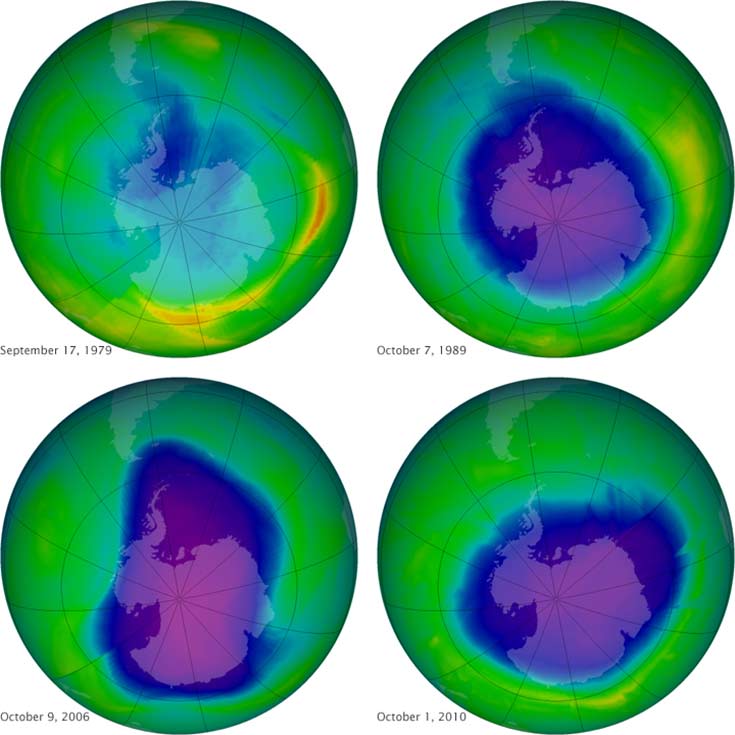

Environmental news tends to arrive in shades of alarm. Amid that steady drumbeat of warnings, one story stands apart, because it is a genuine success. High above our heads, a wound in the atmosphere that once ranked as humanity’s most pressing environmental crisis is closing. The ozone layer is healing, and it is healing because the world decided, decades ago, to act on what science was telling it.
A Shield in the Stratosphere
The ozone layer is a band of the stratosphere, roughly nine to nineteen miles above the surface, where ozone molecules are especially concentrated. Each of these molecules is made of three oxygen atoms, and together they perform a quiet but vital job. They absorb most of the sun’s ultraviolet radiation before it reaches the ground, acting as a kind of planetary sunscreen.
Without that protection, life on the surface would face a harsher sun. Excess ultraviolet exposure raises the risk of skin cancer and cataracts in people and damages ecosystems, from crops to the tiny organisms at the base of ocean food webs. For most of history, this shield went unnoticed. It became famous only when it started to fail.
The Crisis of the 1980s
In the 1980s, scientists made an alarming discovery. Every southern spring, a vast hole was opening in the ozone layer over Antarctica. The culprit was traced to a group of manufactured chemicals called chlorofluorocarbons, or CFCs, which were widely used in refrigerants, aerosol sprays, and foams. Once released, these chemicals drifted up into the stratosphere, where they broke apart ozone molecules with startling efficiency.
The response was, by the standards of international politics, remarkably swift. In 1985 the Vienna Convention formally recognized ozone depletion as a global problem. Two years later, the Montreal Protocol committed nations to phasing out the chemicals responsible. It became one of the most successful environmental treaties ever written, eventually ratified by every country in the world, and its restrictions began to bite through the 1990s.
The Evidence of Recovery
Four decades on, the results are visible in the atmosphere itself. The World Meteorological Organization, which issues regular assessments with the United Nations Environment Programme, reported that the ozone hole over Antarctica in 2024 was smaller than in recent years. Over most of the planet, total ozone levels were higher than the recent average. The organization was careful to note that part of the improvement came from natural year-to-year fluctuations in the atmosphere, but the long-term trend reflects the success of concerted international action.
The following year reinforced the picture. Scientists reported that the 2025 Antarctic ozone hole was relatively small and short-lived. According to the United States National Oceanic and Atmospheric Administration and NASA, it was the fifth smallest since 1992, the year the Montreal Protocol’s phase-out began to take effect. Monitoring services noted that the hole closed on the first of December, the earliest closure since 2019.
A Timeline for Full Repair
Recovery on this scale is slow, because the chemicals already released linger in the stratosphere for decades. Still, the projections are encouraging. The most recent scientific assessment estimated that, if current policies hold, the ozone layer should return to its 1980 condition, before the hole appeared, by around 2040 for most of the world, by 2045 over the Arctic, and by around 2066 over the Antarctic, where the damage was always deepest.
The head of the United Nations captured the mood plainly, stating that the ozone layer is healing. He framed it as proof that progress is possible when nations heed the warnings of science. That framing matters, because the ozone story has become a template for what effective global cooperation can achieve.
The Work Is Not Finished
For all the good news, scientists are quick to warn against complacency. The recovery depends on continued adherence to the rules already agreed, and new pressures could slow it down. Extreme events linked to a warming planet pose a particular threat. The intense wildfire smoke from Australia’s Black Summer of 2019 and 2020, for instance, was found to have destroyed about one percent of the ozone above the Southern Hemisphere.
There is also a twist involving the very chemicals brought in to replace CFCs. A 2016 addition to the Montreal Protocol, the Kigali Amendment, targets hydrofluorocarbons. These do not harm the ozone layer, but they are potent greenhouse gases that contribute significantly to global warming. Repairing one problem, in other words, risked worsening another, and the treaty had to evolve to address it.
A Lesson Worth Remembering
The most valuable part of the ozone story may be the lesson it carries into other environmental challenges. It shows that a global problem can be diagnosed by science, acted on by governments, and genuinely solved. Some of the scientists involved have pointed out that the climate challenge is far more complicated, tangled up with the entire global economy in a way that a handful of industrial chemicals never were.
Yet the underlying principle holds. Identify the danger early, act decisively, and improve the response as the science sharpens. The ozone layer is proof that this approach works. Somewhere above Antarctica, a hole that once symbolized humanity’s capacity to damage its own planet is quietly becoming a symbol of our capacity to repair it.